Stream input data#
import warnings

import cartopy
import cartopy.crs as ccrs
import matplotlib as mpl
import matplotlib.pyplot as plt

import tams

warnings.filterwarnings("ignore", category=cartopy.io.DownloadWarning)
GPM precipitation and brightness temperature#
With the help of earthaccess, we can stream these data without downloading the files to disk.
%%time

pr = tams.data.get_imerg("2024-06-01 02:30")["pr"]
pr
CPU times: user 620 ms, sys: 199 ms, total: 819 ms
Wall time: 9.59 s
<xarray.DataArray 'pr' (lat: 1800, lon: 3600)> Size: 26MB
[6480000 values with dtype=float32]
Coordinates:
    time     datetime64[ns] 8B 2024-06-01T02:30:00
  * lon      (lon) float32 14kB -179.9 -179.9 -179.8 ... 179.8 179.8 179.9
  * lat      (lat) float32 7kB -89.95 -89.85 -89.75 -89.65 ... 89.75 89.85 89.95
Attributes:
    units:        mm/hr
    long_name:    precipitation rate
description: Complete merged microwave-infrared (gauge-adjusted) precipi...%%time
tb = tams.data.get_mergir(pr.time.item())["tb"]
tb
CPU times: user 76.5 ms, sys: 28.8 ms, total: 105 ms
Wall time: 17.1 s
<xarray.DataArray 'tb' (lat: 3298, lon: 9896)> Size: 131MB
[32637008 values with dtype=float32]
Coordinates:
  * lon      (lon) float32 40kB -180.0 -179.9 -179.9 ... 179.9 179.9 180.0
  * lat      (lat) float32 13kB -59.98 -59.95 -59.91 ... 59.91 59.95 59.98
    time     datetime64[ns] 8B 2024-06-01T02:30:00
Attributes:
    units:          K
    standard_name:  brightness_temperature
long_name: brightness temperature%%time
fig = plt.figure(figsize=(12, 5), layout="constrained")
ax = fig.add_subplot(projection=ccrs.PlateCarree())
ax.coastlines(color="magenta")
cmap = plt.get_cmap("gist_gray_r")
cmap.set_bad("red")
tb.plot(x="lon", cmap=cmap, robust=True, ax=ax)
pr.plot(x="lon", norm=mpl.colors.LogNorm(0.01, pr.quantile(0.99)), alpha=0.85, ax=ax);
CPU times: user 7.64 s, sys: 3.49 s, total: 11.1 s
Wall time: 16 s
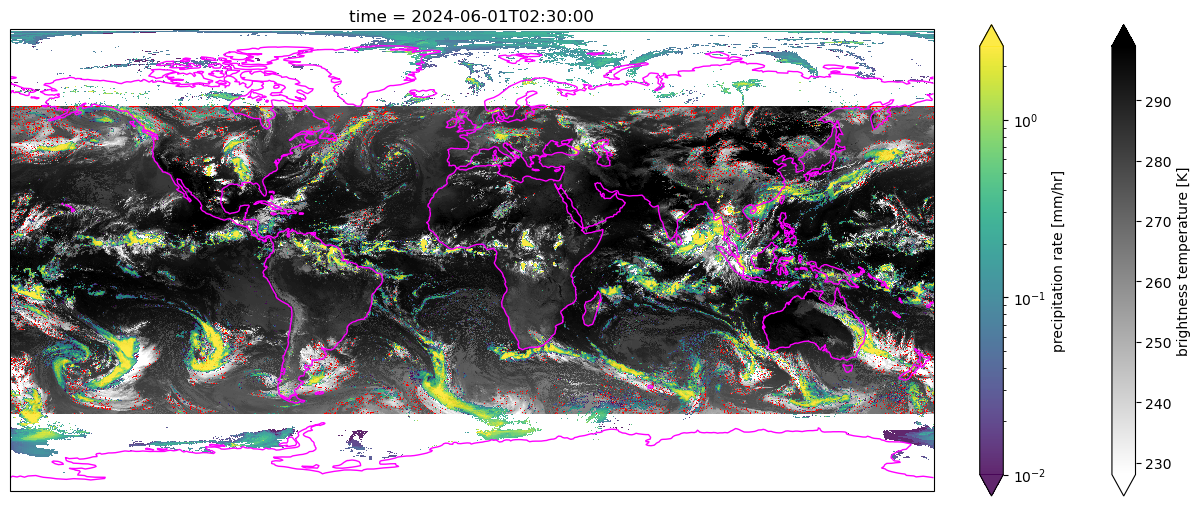
The red dots in the brightness temperature field above represent missing data. For most CE identification methods, this will influence results. Since they are mostly scattered points, not large regions, a reasonable way to fill in the missing data is a nearest-neighbor interpolation.
%%time

kws = dict(method="nearest", fill_value="extrapolate", assume_sorted=True)
tb_ = tb.interpolate_na("lat", **kws).interpolate_na("lon", **kws)

print(f"{tb.isnull().sum().item() / tb.size:.3%} -> {tb_.isnull().sum().item() / tb_.size:.3%} null")
2.231% -> 0.000% null
CPU times: user 1.1 s, sys: 97.4 ms, total: 1.2 s
Wall time: 10.4 s
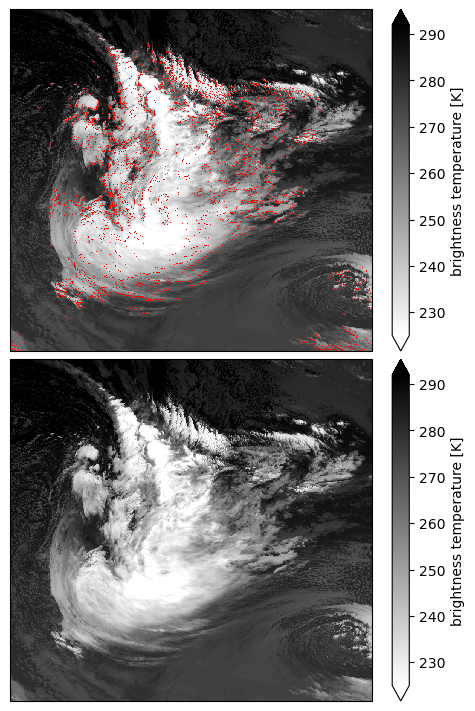
We zoom in to the system off the coast of Chile to demonstrate the impact.
box = dict(lon=slice(-115, -80), lat=slice(-53, -20))

fig, [ax1, ax2] = plt.subplots(
    2, 1,
    figsize=(5, 7),
    sharex=True, sharey=True,
    subplot_kw=dict(projection=ccrs.Mercator()),
    layout="constrained",
)

tb.sel(box).plot(cmap=cmap, robust=True, ax=ax1)
ax1.set_title("")

tb_.sel(box).plot(cmap=cmap, robust=True, ax=ax2)
ax2.set_title("");